

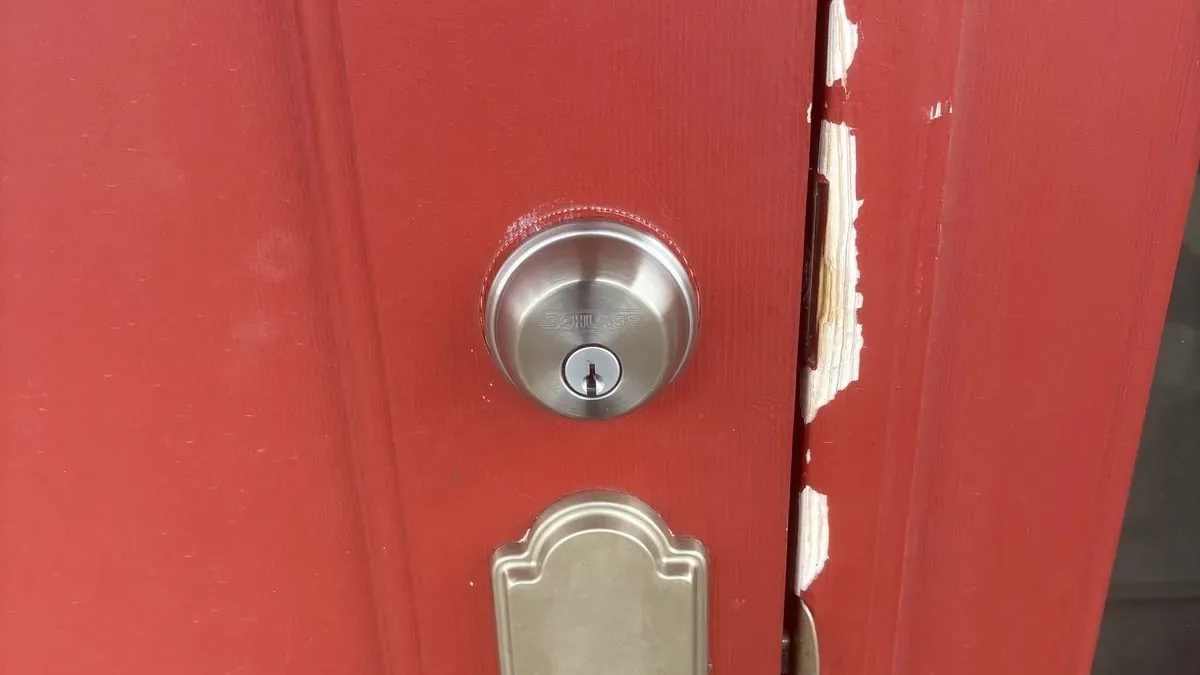
A kicked-in door almost never fails at the lock. It fails at the frame: the deadbolt stays locked, and the strip of wood around the strike plate splits off the jamb. The fix is to anchor the strike plate and hinges into the wall stud with 3-inch screws, add a reinforced strike or a jamb reinforcement plate, and make sure the deadbolt throws its full inch. Most homes can get there in an afternoon.
I bring it up now because it is a question I am hearing more on calls. In early September, police reported an intruder forcing his way into an apartment on the north side of Colorado Springs, and every report like that sends people out to look hard at their own front door. Here is what a locksmith looks at when a door has to stand up to a kick, in the order it actually matters.
Why Doors Give Way at the Jamb, Not the Lock
Picture what holds your deadbolt in place. The bolt slides into a hole in the door jamb, and a thin metal strike plate covers that hole. On most builder-grade doors the strike plate is held on by two short screws, often about three-quarters of an inch long, that only bite into the jamb itself. Behind the jamb is a gap for shims, and behind that is the wall stud, which is the only piece of wood strong enough to take a real blow.
So when someone kicks the door near the lock, the force goes straight into a strip of soft pine held on by two short screws. The bolt does exactly its job and the wood around it breaks away. That is what the photo at the top of this page shows: the deadbolt is fine, and the jamb has splintered along the strike.
- Short strike plate screws that never reach the stud.
- Hinge screws of the same short length, which let the hinge side tear out too.
- A bolt that does not fully extend, because the door and frame are out of line.
The Fix That Matters Most: 3-Inch Screws
If you do only one thing, do this. Take out the short screws on the deadbolt strike plate and replace them with 3-inch screws driven through the jamb and the shim gap into the stud. Do the same with at least one screw on each hinge, ideally the one closest to the door stop. Pre-drill so the jamb does not split, and stop tightening once the plate is snug, because overdriving a long screw can pull the jamb toward the stud and leave the door binding.
Unscrew one strike plate screw and look at it. If it is shorter than your finger, your lock is only as strong as the trim it is screwed into.
Why this is worth checking in Colorado Springs
Our dry air and big temperature swings are hard on wood. Jambs dry out and shrink, screw holes loosen, and the gap between the door and the strike grows over a few winters. Many of the newer tract homes on the north and east sides and out in Falcon also use finger-jointed pine jambs, which are fine for looks and weak under a kick. If your deadbolt now needs a push or a lift on the door to lock, the frame has already moved, and that same gap is where the leverage comes from.
Strike Plates, Jamb Kits and Hinge Reinforcement
Longer screws are the first step. These are the upgrades that go on top of them, roughly in order of how much they add.
A reinforced or box strike
A heavy-gauge strike plate with four or more screw holes, sometimes with a steel box that lines the bolt hole, spreads the force of a kick across more of the jamb and stud. It is a small part and one of the best values in door security.
A jamb reinforcement plate
For a door that has been kicked before, or a frame that is already cracked, a long steel plate that runs up the jamb behind the strike area turns the whole latch side into one piece instead of a strip of trim. These kits are made for standard doors and fit under the casing, so from the outside the door looks the same.
The hinge side
On an outward-opening door the hinge pins are exposed and should be non-removable. On the usual inward-opening front door, long screws in each hinge do most of the work, and a hinge-side reinforcement plate covers the rest.
The door and the deadbolt itself
A hollow-core door will not hold a strong frame together, so an exterior door should be solid wood, steel or fiberglass. The deadbolt should be a quality single-cylinder model with a full 1-inch throw. If a glass panel or sidelight sits within reach of the thumb turn, talk to a locksmith before choosing a lock, because a keyed inside cylinder trades one risk for another if you ever need to get out fast in a fire.
How to Check Your Own Door in Ten Minutes
You do not need tools beyond a screwdriver to know where you stand.
- Remove one screw from the deadbolt strike plate and one from the top hinge, and measure them. Anything under about 2 inches is not reaching the stud.
- With the door open, extend the deadbolt and measure how far it sticks out. You want a full inch. Then close the door and lock it. If you have to push, pull or lift the door to make the bolt slide, the frame is out of line.
- Look closely at the jamb around the strike and along the hinge side for hairline cracks, old filler, or paint that has split along a line. Those are signs the frame has already taken a hit.
- Do the same check on the door from the garage into the house and on any side or back door. They are often the weakest doors in the home and the least looked at.
Pro Tip from Locksmith Solutions LLC
Clocks go back on November 1, and the dark evenings that follow are when people first notice how exposed a back or side door feels. Do this check before then, and do it on every exterior door, not just the front.
Renters, Condos and Apartments
If you rent, ask your landlord or property manager before changing locks or hardware, and get the answer in writing. Swapping short strike and hinge screws for longer ones changes nothing about how the door looks or works, and many landlords will agree to it or have it done. If a door has already been forced, report it to the landlord the same day, because a damaged frame is a repair the building should know about.
After a Kick-In: Repair the Frame Before the Lock
If your door has already been forced, putting a new deadbolt into a split jamb leaves you exactly as exposed as before. The frame has to be repaired or reinforced first, then the lock goes back into solid wood. If keys may also have been taken, the cylinders should be rekeyed or changed at the same visit. Our guide to lock replacement after a break-in walks through what to do in the first hours, and our emergency locksmith service covers securing a damaged door the same day.
For a door that has not been tested yet, the work is usually a single visit: longer screws, a reinforced strike, a jamb plate where the frame needs it, and a properly aligned deadbolt. That is what our deadbolt installation service covers across Colorado Springs, Monument, Fountain, Falcon and Security-Widefield, and for doors that need more than that, high-security locks are the next step.
Frequently Asked Questions
Do door jamb reinforcement kits really work?
Yes, when they are installed into the stud. The kit works by tying the strike area of the jamb to the framing behind it with long screws, so a kick has to break the stud rather than a strip of trim. A kit fastened only into the jamb adds very little.
Will 3-inch screws damage my door frame?
Not if you pre-drill and stop once the plate is snug. Overtightening a long screw can pull the jamb inward and make the door rub or the bolt bind. If that happens, back the screw out a turn until the door closes cleanly.
Is a smart lock harder to kick in than a regular deadbolt?
Not by itself. A smart lock is still a deadbolt going into the same strike and the same jamb. It helps with key control, but kick resistance comes from the frame, the strike and the screws, so reinforce those whatever lock you choose.
Need a locksmith in Colorado Springs?
Call Locksmith Solutions LLC for fast, honest, mobile locksmith service. We are available Monday to Friday, 7:00am to 9:30pm, and Saturday and Sunday, 8:00am to 9:00pm, across Colorado Springs and El Paso County.