

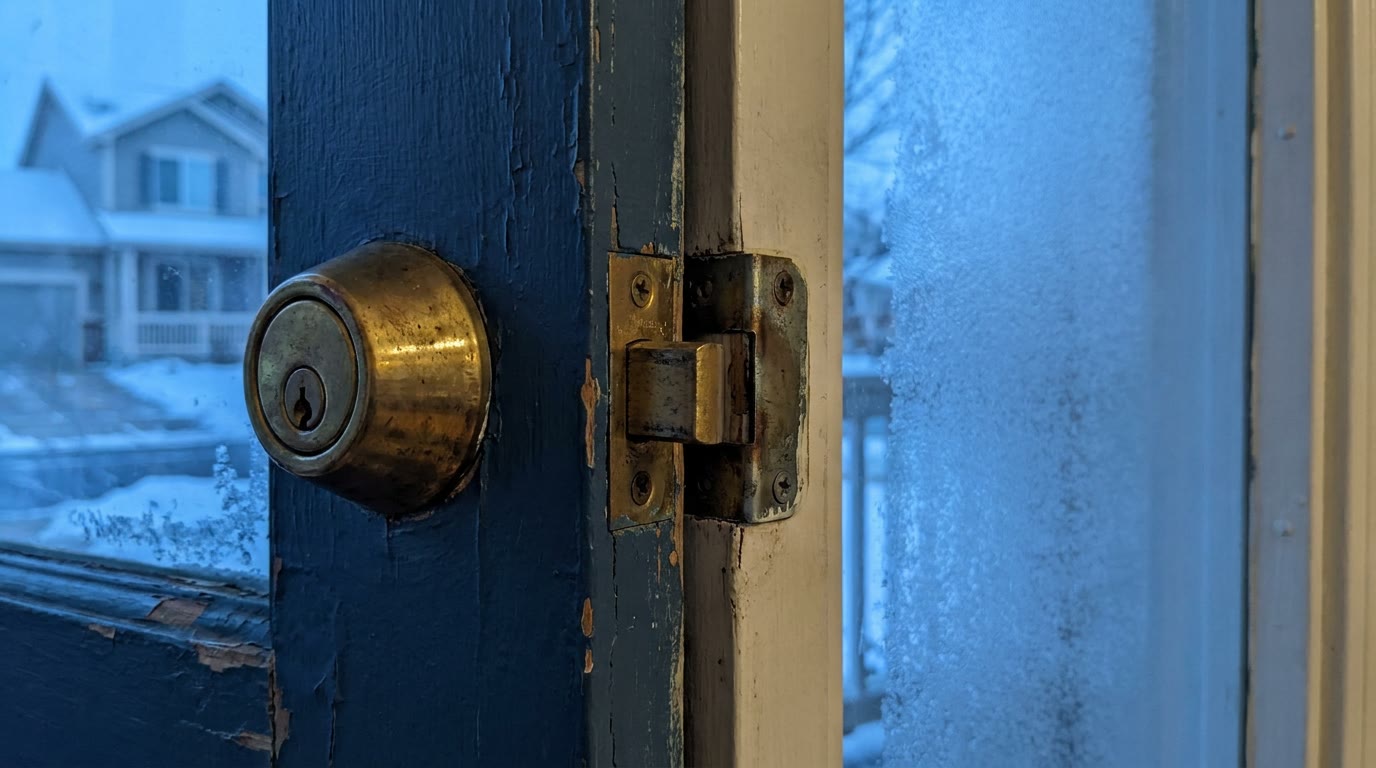
A deadbolt that gets hard to lock when the weather turns cold is usually not a broken lock. Most of the time the door and the frame have moved a little, so the bolt no longer slides straight into the hole in the strike plate and drags against its edge instead. Less often the lock itself is stiff, because old oil has thickened in the cold or moisture got into the keyway. A ten-second test tells you which one you have: open the door and turn the deadbolt. If it throws easily with the door open, the problem is alignment, not the lock.
This is the week the question starts. The National Weather Service in Pueblo put parts of El Paso County under a freeze warning through Friday morning, October 16, with lows in the upper 20s to low 30s, and another freeze watch for Friday night. The first cold nights are when we start getting the same call around Colorado Springs: "the key turns hard", "I have to pull the door to lock it", or "the bolt only goes halfway".
The Ten-Second Test: Is It the Door or the Lock?
Before you spray anything into the lock, find out where the drag is.
- Open the door and turn the thumbturn on the inside so the bolt slides all the way out, then back.
- Do the same with the key from the outside, still with the door open.
- Close the door and lock it again. Notice whether you have to push, pull or lift the door to get the bolt to go.
If the bolt moves smoothly with the door open and only fights you when the door is closed, the bolt is rubbing on the strike plate. That is the door, the hinges or the frame. If it is stiff even with the door open, the problem is inside the lock: the cylinder, the bolt mechanism or the lubricant.
Why Cold Weather Throws the Bolt Out of Line
A deadbolt only needs a few millimeters of misalignment to start dragging. Several things move a door that much when the temperature drops.
Dry cold air shrinks wood doors and frames
Colorado Springs air is dry most of the year and drier still once the furnace runs all day. A wood door and its jamb give up moisture and shrink slightly across the grain, and the gap at the latch side changes. A bolt that lined up in August can end up hitting the top or bottom edge of the strike hole by November.
Big swings between day and night
At this altitude a south or west facing door can sit in strong sun in the afternoon and drop below freezing a few hours later. Steel and fiberglass doors expand and contract with that swing, and the weatherstripping goes from soft to stiff. A stiff seal pushes the door outward against the stop, which moves the bolt away from the center of the strike hole.
Sagging hinges and loose screws
The top hinge carries most of the door's weight. If its screws only reach into the jamb, the door slowly sags toward the latch side and the bolt drops low in the strike. Cold weather does not cause this, but it is often the last few millimeters that turn a slight sag into a deadbolt you have to fight.
A strike plate that was never quite right
Many builder-grade installs around Colorado Springs, Fountain and Falcon have a strike hole drilled shallow or slightly off. It worked in mild weather. The first cold snap exposes it.
If you have to lean on the door or lift the handle to lock it, the lock is telling you the bolt and the strike no longer line up. Forcing it every day wears out the lock that was never the problem.
When the Lock Itself Is Stiff
If the test showed drag with the door open, look at the lock rather than the door.
- Old oil that thickens in the cold. Household oil and grease attract dust, and in cold weather they turn into a sticky paste inside the cylinder. The key goes in but turns hard, especially first thing in the morning.
- Moisture that freezes in the keyway. Snow blown against the door or condensation can freeze inside the cylinder overnight. If the key will not go in at all, that is ice, and our guide on how to open a frozen door lock covers how to thaw it safely.
- A worn key or worn pins. A key copied from a copy, or a lock that has been forced for years, binds more as the metal contracts. Try the original key if you have one.
- A smart lock motor that stalls. Batteries lose power in the cold, and a motorized bolt that was barely clearing the strike in summer may stop halfway and report a jam. Alignment problems show up on smart locks first.
What You Can Safely Try Yourself
- Tighten the hinge screws, especially on the top hinge. If a screw spins without biting, a longer screw that reaches into the framing behind the jamb often lifts the door back into line.
- Check where the bolt hits. Rub a little lipstick or a dry-erase marker on the end of the bolt, close the door and turn it gently. The mark on the strike plate shows whether the bolt is hitting high, low or on the side.
- Use a dry lubricant, sparingly. A puff of graphite or a dry PTFE lock lubricant into the keyway is right for a cold climate. Skip heavy oil and grease, which make the cold-weather stiffness worse over time.
- Do not force the key. A key twisted hard in a cold, stiff cylinder is how keys snap off inside the lock. If it will not turn with normal pressure, stop.
Pro Tip from Locksmith Solutions LLC
Do the open-door test on your front door and the door from the garage into the house this week, before the colder nights later this month. A deadbolt that only goes halfway is not locked, even if the thumbturn looks turned. The bolt needs to go all the way into the frame to hold the door.
When It Is Time to Call a Locksmith
Some of these fixes are simple for a homeowner. Others need the strike moved, the hole deepened, or the lock rebuilt, and that is where we come in.
- The bolt does not fully extend when the door is closed, even after you tighten the hinges.
- The key turns hard with the door open, and lubricant did not help.
- The strike plate needs to move or the hole needs to be deeper or wider.
- A key broke off in the lock. That is a job for broken key extraction, not pliers.
- The lock is old, worn or cheap enough that it is time for a new one. A properly fitted deadbolt installation includes setting the strike so the bolt throws freely in every season.
Our lock repair in Colorado Springs covers realigning the strike, adjusting the door, cleaning and servicing a stiff cylinder, and replacing parts that are worn. For motorized deadbolts we also handle smart lock installation and adjustment, so the bolt clears the strike with room to spare in January.
Frequently Asked Questions
Why does my deadbolt lock easily in summer but not in winter?
Because the door and frame are not the same size in both seasons. Dry, cold air shrinks wood, temperature swings move steel and fiberglass doors, and weatherstripping stiffens. Any of these can shift the bolt off center from the strike hole by a few millimeters, which is enough to make it drag.
Can I use WD-40 on a deadbolt that is hard to turn?
It may free it for a day, but it is not a lock lubricant and it collects dust, which makes the lock stiffer in the cold later. Use a small amount of graphite or a dry PTFE lock lubricant instead.
Is it safe to leave a deadbolt that only goes halfway?
No. A bolt that does not fully extend into the frame can often be pushed back, and it does not hold the door the way it should. Fix the alignment so the bolt throws all the way.
Should I file the strike plate myself?
Small adjustments are possible with a file, but if the bolt is off by more than a little, the strike plate usually needs to be moved and the hole in the jamb extended. Doing that cleanly keeps the frame strong. If the frame is cracked or weak, see our guide on how to reinforce a door frame.
A deadbolt that is hard to lock in Colorado Springs?
Call Locksmith Solutions LLC. We realign strikes, service stiff locks and fit new deadbolts during our hours: Monday to Friday, 7:00am to 9:30pm, and Saturday and Sunday, 8:00am to 9:00pm, across Colorado Springs, Fountain, Falcon, Monument, Security-Widefield and Manitou Springs.